Garima Goyal Journal
Self Management
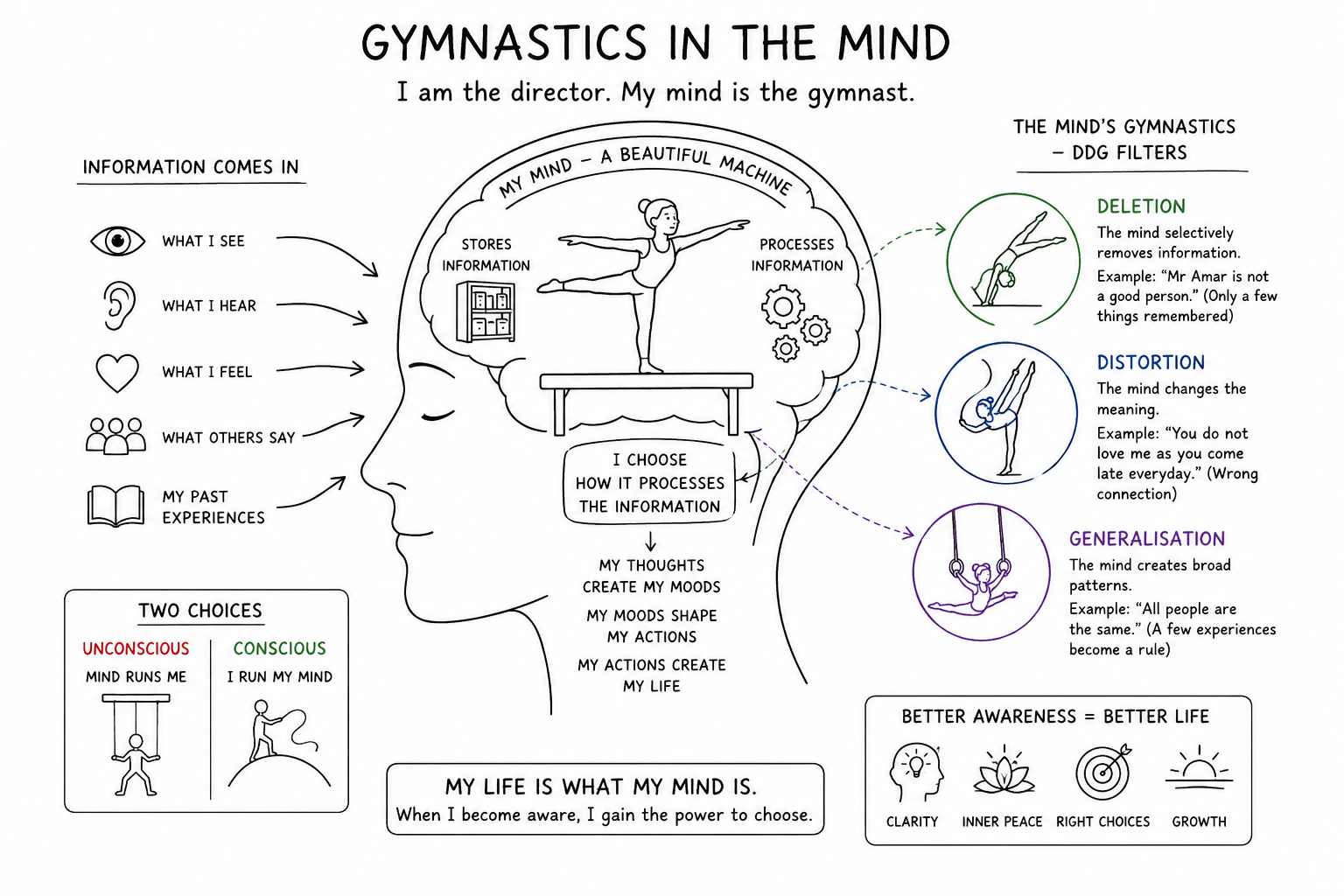
You are what your mind is. Lets learn a little about the working of our mind so we can build in elasticity in ourselves to get into the resourceful state of the mind.
Self Management How many decisions does your mind make in a single day? Most of these decisions happen unconsciously. We often experience them as moods, reactions, likes, dislikes, fears, assumptions, or impulses. These inner states quietly influence our behaviour, relationships, health, and the direction of our lives. But where do these moods come from? They are created by the way our mind processes information. Let us observe the difference between these statements: • Life is hard. • Life is a flow. • I am healthy. Now compare them with: • The world is a hard jungle to live in, but I am the King. • Life is like a flowing river. • My health is like the rising sun. The second set creates movement, imagery, emotion, and energy inside the mind. The mind does not merely hear words; it experiences pictures, meanings, and associations. The language we use becomes the architecture of our inner world. I begin with the sentence: “My life is what my mind is.” But what exactly is the mind? The mind is a beautiful machine for storing, organising, and interpreting information. The way this information is processed makes all the difference to our experience of life. The real question is: Am I processing life consciously, or unconsciously? Is my mind running me, or am I learning to run my mind? Through this workshop, we shall explore the understanding that the mind is a tool — and we have the ability to influence how it interprets reality. Understanding the Mind: Deletion, Distortion & Generalisation Our mind continuously filters information through three natural processes: • Deletion • Distortion • Generalisation I call them the DDG filters of the mind. Without these filters, the brain would be overwhelmed by the enormous amount of information entering every moment. DDG helps the mind simplify reality so it can function efficiently. However, these same filters can also create misunderstandings, emotional reactions, and limiting beliefs. Let us understand them more clearly. 1. Deletion – The Mind Selectively Removes Information The brain cannot consciously process everything around us. So, it deletes certain details and keeps only what it considers important. For example: • In a crowded room, you suddenly hear your name. • While driving, you ignore thousands of unnecessary visual details. • You may remember criticism from a conversation but forget the appreciation. Example: “Mr. Amar is not a good person.” This may simply mean the mind has selectively remembered a few unpleasant experiences while deleting many neutral or positive ones. Deletion is useful because it reduces mental clutter. But unconscious deletion can also make our perception incomplete. 2. Distortion – The Mind Changes Meaning Distortion happens when the mind interprets reality in a way that may not actually be true. The brain fills gaps with assumptions, imagination, fear, memory, or emotional meaning. Example: “You do not love me because you come late every day.” Coming late may have nothing to do with love. But the mind connects two unrelated things and creates an emotional conclusion. Other examples: • “Nobody replied to my message; they must be upset with me.” • “I failed once, so I am not capable.” Distortion is not always negative. It is also the source of creativity, innovation, storytelling, poetry, and imagination. The same ability that creates anxiety can also create art and vision. 3. Generalisation – The Mind Creates Broad Patterns The brain learns by recognising patterns and grouping experiences together. This helps us quickly understand and navigate life. For example: The word “fan” can refer to: • a ceiling fan, • a table fan, • or even a follower of a celebrity. The word “ball” can mean: • a cricket ball, • a football, • or a dance ball. The mind generalises information so that we do not have to learn every experience from the beginning. But overgeneralisation can also become limiting: • “People cannot be trusted.” • “I always fail.” • “Relationships are difficult.” A few experiences become a rule for life. Becoming Conscious of the Filters Every human being constantly deletes, distorts, and generalises reality. These filters shape not only how we see the world, but also how we see ourselves. The goal is not to remove these filters — they are necessary for the mind to function. The goal is to become aware of them. The role of filters actually is to keep the brain resourceful. If the filters start to make the brain act in unresourceful way, then they have to be assessed for being replaced by the correct ones, Once we become conscious of how the mind processes information, we begin creating space between reality and reaction. In that space, choice becomes possible. And that is where self-management begins. Because ultimately: Your life is not shaped only by what happens to you. It is shaped by how you allow your mind to process what happens to you.
Comments
0 comments